
“But the ancient Macedonians used to make important decisions only when inebriated, the idea being that only when mentally lubricated are you free of the societal filters and self-doubt. Therefore you think and act as your true self. Therefore you are thinking and acting truthfully, and hence correctly.” [via Jason Cohen]
Tag Archives: business
The NFL, Google TV, and DirecTV’s Death Grip on the Sunday Ticket
If you’ve spent any time with me in person or paying attention to my tweetstream at all (especially on Sundays), you know about my love affair with football, the NFL and the Baltimore Ravens specifically.
I’ve gone nearly 11 years and have been at or watched every Ravens game in that time. I used to watch these games at my home in Baltimore when I was in-market, but then I moved to DC. Oddly (though I do understand the NFL marketing rules), being 45 minutes away put me “out of market” and into Redskins country. Acknowledged.

It began my weekly Sunday tradition of going to local sports bars to watch the game every Sunday. When I was in Virginia, that was the very awesome Crystal City Sports Pub (ask for John, tell him I sent you and order a cup of coffee… watch for his reaction :-p). When I moved back to Maryland, I went to one of several on Sundays.
Now that I’m in Austin, I’m fortunate to find The Tavern which serves as the Ravens Nest in Austin. 50 or so fans, most of whom have roots in Baltimore, show up every week to cheer on our “Death on Wings”.
But here’s the problem. I have Time Warner Cable. I can’t get non-nationally televised games at home. The only way I could would be to switch to DirecTV and pay several hundred dollars for the NFL Sunday Ticket. This is a problem for someone who doesn’t watch much TV anyway, and the TV shows I do watch, I catch on Hulu or TV.com. Sure, I enjoy ESPN SportsCenter when I need to have some noise on in the background so I can get work done, but otherwise, the TV is rarely on.
I’ve got Netflix DVDs and can stream many shows and movies instantly on Netflix to my XBOX 360. With my (free for me) 40″ HDTV, I can stream MLB.tv games, or if I chose, NHL GameCenter games from my laptop direct to my television. I can do the same with NBA Leaguepass (though I won’t because I hate the NBA).
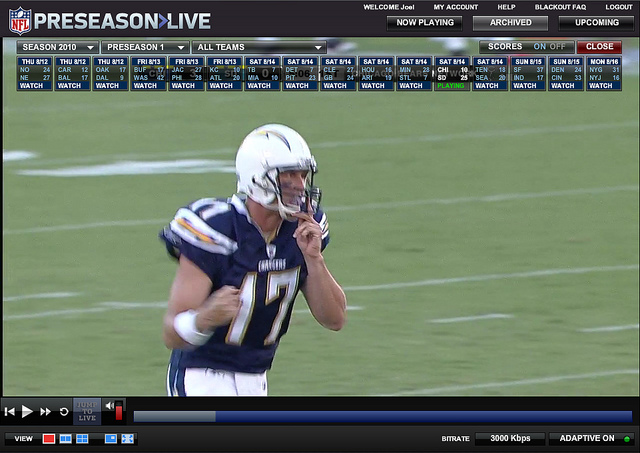
The NFL really offers no option to U.S. customers except via NBC’s live streaming of Sunday Night Football. (Though they did offer Preseason streaming games online – see the picture above).
There is a lot of money tied up in contracts for the transmission and coverage of NFL games. I realize it. But there needs to be a change. Consumers would be thrilled to subscribe to an NFL.tv-style service that would allow them to access their favorite sport online. It could be setup in a variety of ways. The NFL could charge a flat fee of $160 for access to a single team feed with a higher-priced “all access pass” – perhaps $300. They could also charge for a pay-per-view format of $10/game where, if I’m compelled by the Colts-Patriots game, I could purchase a single game pass.
The money will continue to be with DirecTV and I’m not suggesting that their contract should be killed in favor of an all-streaming model. No, in fact, the real money for the NFL Sunday Ticket comes from bars that are paying a premium package to offer all the NFL-licensed content on 50+ TVs. That money will still be there. You could easily restrict distribution and force bars to buy from DirecTV. Money in the bank.
But for consumers, especially those who are fans of teams outside of their market, giving them the opportunity to invest in the NFL, expand distribution, embrace the technology available in 2010, having a streaming option would be a huge WIN.
In fact, I’m willing to bet on a net 10% increase in viewership/subscribers based on this model. At least.
Google TV was just announced the other day. We don’t know much about it yet, but we do know that networks are going to have their own portals. This seems like a great possible partnership for the NFL and Google!
The only question that remains, then, is if the NFL has enough balls to make the big move? I think they need to, lest piracy and viewership decline.
Am I crazy?
Photo by Joel Price
Everything I Needed to Know About Entrepreneurship, I learned from Star Wars

Star Wars. The original Star Wars. Perhaps those movies were defining films of our time. Though the first title (aptly numbered Star Wars IV) was filmed in the late 1970s, it continues to define movie nerddom today. Of course, Star Wars has seen somewhat of a renaissance due to the licensing of the intellectual property for the creation of video games like LEGO™ Star Wars and the continual memeage (is that a word?) of Yoda and Darth Vader quotes.

Nonetheless, it, like any good story, is successful in no small part due to the parallels in life that can be drawn. Much like how Office Space taught me about Public Relations, Star Wars taught me about entrepreneurship.
Don’t doubt me. The nuggets of wisdom are strewn throughout. In fact, I’ve developed my entire professional life around Star Wars. 1 You don’t believe me? Check this out.
Always Two There Are, a Master and an Apprentice
No matter how good you are in your professional life, there is always someone better. Yoda reminds me that, there should always be someone I look up to for learning. Sometimes this person (or people) is better than you at what you do. Other times, this person (or people) is someone who excels in a complementary way.
One of the founders of WP Engine, Jason Cohen, is one of these guys. Jason is amazingly technically (if I can keep him away from Javaisms while writing PHP code) and is the brainchild behind our infrastructure. More importantly, the dude is one of the savviest businessmen around in a completely unassuming way. He is not the guy who is going to walk into a meeting a toot his own horn like some investors or entrepreneurs do. He simply is and carries chutzpah. I have not known Jason very long but in the time I have, I’ve developed a real appreciation for him.
Likewise, Geoff Livingston has become a close friend but he’s also an incredibly focused entrepreneur. I’ve known Geoff since his early days where he was running a social media PR firm out of Alexandria, VA. Geoff and I became close but it wasn’t until I lived with him for six months in 2008-09 that I realized the drive this kid had. He frequently asked for my advice on things that were happening professionally, all of which will remain off the record in the circle of trust.
However, he has demonstrated since that he knows how to make tough decisions and go after what he believes in. Earlier this year, Geoff co-founded Zoetica to assist non-profits and socially conscious companies in their communications efforts. His drive has led him to lead in the CitizenGulf effort to raise money for oil spill cleanup in the Gulf, and to raise awareness and change in the policy world.
His dedication to his cause is something I’m watching and learning from.
Yahoooooo! You’re all clear, kid. Now let’s blow this thing and go home
Remember when the Death Star invasion was happening in Star Wars IV? The X wings were being pursued down the trough by TIE fighters. Darth Vaders fighter was on the hunt to blow Luke away. Han Solo brings his Millenium Falcon into play at the last minute and with some perfectly timed shot, knocks Vaders fighter into oblivion allowing Luke to handle his business and blow the Death Star away.
In business, the ultimate goal is always to have an exit. If it’s not, you’re holding it wrong. You don’t want to stay in a job forever. You may want to delay because you have more you want to do with the startup before selling it, but at the end of the day, if you’re putting blood, sweat and tears into a startup… you want the big pay day at the end.
This is what drives many entrepreneurs to settle for less money in exchange for more equity in the startup. Get less cash now for way more cash down the road.
Like the Death Star invasion, startup mode will have you fighting a guerrilla war at times… fighting for your survival… skirmishing to get a leg up. Once you’re clear and have done everything you can to get the company to a specific place, cash in! Blow this thing and go home. Live to fight again another day.
Aren’t you a little short for a stormtrooper?
One of the more hilariously ridiculous quotes from Star Wars IV came from Leah when Luke rescued her from being executed by the Empire.
The takeaway from this quote is pretty simple… never let anyone denigrate what you do as an entrepreneur. There will always be second guessing and there will always be other entrepreneurs who feel like thy know better and can offer advice. You know your company better than anyone else. You know your decision-making fiefdom better than anyone else. Own your offense and maintain confidence in what you do, and what you are building.
Luke, there is another Sky….walker…
The dying words of the Jedi Master Yoda. These words were the clue to Luke that he had a twin. That there could be another Jedi candidate. That there could be another Skywalker to defeat the evil Empire.
In the Lean Startup mode of starting businesses, the idea is to fail and fail fast if you’re going to fail at all. That way, if you fail and fail quickly, you can learn quickly without having put a lot of time and effort into something that will never work. Taking lessons learned, you can move on to the next startup and try again. Keep in mind that, statistically, 9 out of 10 companies fail. There is nothing wrong with failure as long as you realize there is another around the corner.
There is another Skywalker. There is another idea. There is another startup. And there may be another failure.
Arrrrrrrrrrrrrrrgh!
We don’t know specifically what Chewbacca was talking about when the Millenium Falcon’s hyper drive system failed. If there are any Wookie translators in the audience, please step to the front of the room. However, we can deduce that, based on what we know of Chewie, that he was doing tactical consulting.
In other words, it’s my opinion, that Chewie was making sure Han knew that there was a lot of problems with the Millenium Falcon and it wasn’t like they had the money to fix the bucket of bolts. Chewie was suggesting solutions for Han to fix problems quickly without spending a lot of money. I mean, can you imagine if Han had to take a VC round to fix the Falcon? What would the valuation on that sucker be anyway? I’m sure it would be a diluted round.
Instead, Chewie was helping Han realize what he needed to do to fix the problem on a budget. Maybe even in bandaid fashion. As entrepreneurs, use your creative juices to find ways to self-fund and not take stupid money just so you can extend runway. Find ways to be revenue positive now instead of later. Find ways to cheaply outsource problems so core team members can focus on the core solutions.
See?
See. Everything you need to know about entrepreneurship can be learned from Star Wars. It’s a geek favorite for a reason. I’m sure there are lessons you have learned as well. Feel free to share those.
In the meantime, may the Force be with you.
Photo by xtyler
Notes:
- Not really. No, really.. not really. ↩
The Milk Machine: Finding Business Focus

You know how occasionally you remember things from your childhood which seem fairly mundane but end up being a moment of inspiration and, sometimes, an epiphany. I get these things all the time and I guess it just helps me appreciate my childhood even more.

Back in the late 70s and early 80s, when I was 4-5 years old and my memories were just starting to really stick with me, we were living in the inner city of Buffalo. The neighborhood is tragically drug-ridden today, and it wasn’t a fantastic neighborhood then either. It was inner city. My father grew up on those streets in the Lovejoy neighborhood as a brawler of sorts. Fighting was the problem, not drugs. How times change. But I digress.
One of the memories I remember from those days is the milk machine. This milk machine is an oddity these days. No one buys milk from milk machines and, I’ll be honest, I have no real idea why we did either. But there was a milk machine at the corner of Longnecker St and Lovejoy St and we went to buy our milk there quite often.
Considering there was a Wilson Farms (similar to 7-11) right there as well, one can only assume that mom chose to buy the milk from the machine because it was a better quality or offered a better value.
Which brings me in a long-winded way to my point. Whoever the hell owned that milk machine didn’t exactly have a huge demographic. It was basically people who could walk to it and chose to walk to it instead of Wilson Farms. I’m sure he wasn’t getting rich off the milk machine. But he was serving a very targeted audience and doing so in such a way that wasn’t trying to take over the world and be everything.
If you’ve got a startup… if you’ve got a venture… do not try to be everything to everyone. It just doesn’t work. Know your audience and what makes them tick. Figure out exactly who you’re serving and stay on track. Especially in early stages, venturing outside of the laser-like target is an expensive proposition, especially in the early stages.
Make your milk and make it good and find the machine that earns you money.
Photo Credit Robbie’s Photo Art
Back in Startup Mode… Announcing WP Engine!

Since I moved to Austin, I have been very coy about what I’ve been up to. There’s a reason for that and today I can tell you all about it. Especially since my good friend Marshall over at ReadWriteWeb already has. :-)
It was very interesting. Back in May, my friend Pete Jackson, who works for Intridea, started making a point of introducing me over to Twitter to one of his friends in whatever city I happened to be travelling in at that moment.
It was in this way that I met Sean Cook, the manager of mobile integrations at Twitter in San Francisco and, when I was in Austin visiting in May, he made sure that I met Aaron Scruggs of Other Inbox who has since become a pretty good friend.
It was after that meeting with Scruggs in May that he connected me to one of the smartest guys I’ve ever met, Jason Cohen. Jason is one of the two founding partners at Capital Thought, an Austin-based incubator. Jason has also built several companies and parlayed two of those into healthy exits. I’ve come to have a tremendous amount of respect for his technical and business savvy.
Jason described to me the concept for a business that he was working on along with Cullen Wilson. A premium, WordPress platform that would cater specifically to the customers who want to make sure their blog is always taken care of from a maintenance and upgrade perspective, but also would offer significant value adds that nobody else is providing in a WordPress-optimized environment.

I’ll get to what all those buzzwords mean in a minute. Stick with me.
We started talking about me joining up with them to take this idea to the bank. Shortly after moving down here to Austin, I joined the team and we’ve been working hard over the last couple months to get to the point where we could reliably take on new customers and talk about our idea publicly.
Today is that day.
So, you’re still probably wondering what the hell WP Engine is and why it’s important, right?
Let’s talk security for a minute. There have been significant security “incidents” in recent months. Most people on the outside simply see “WordPress hacked! WordPress hacked!” – I’m looking at you Chris Brogan, Robert Scoble and Frank Gruber (Techcocktail). In the WordPress community, we know the real issues in these cases were not WordPress but the hosts that the blogs were on. Still, people saw WordPress hacked.
We take this very seriously and have partnered with a provider that has multiple levels of security including Intrusion Detection Systems (IDS) outside of our boxes. We have gone to great lengths to keep our customers connecting to us in very secure ways and keep a close eye on the activity happening on our boxes. This is all very important because if an attacker could get through our outside defenses, chances are they couldn’t do anything malicious without us knowing about it.
Our infrastructure is also built with optimization and blazing, fast speed as a core expectation and deliverable. We don’t overload servers and have the means to see potential performance problems before they arrive. With our dual nginx-apache server configuration, we are able to handle sustained high-volume traffic as well as spikes that are the pain point for WordPress bloggers who suddenly get a story featured on a prominent site.
For the people who claim WordPress doesn’t scale… I call bullshit. We believe we know exactly how to make WordPress scale.
But we’re not just a hosting company. If we were that, we would be our competitors. We are also working on additional features such as “Curated Plugins” which are plugins that are entirely open source, that are popular or in demand from our customers and have been vetted from a security standpoint. These are plugins that we support 100%. This does not preclude customers from using other non-supported plugins, and we don’t dictate what bloggers can have on their blog as some of the other hosted WordPress solutions do. We just say, “Hey, if you use one of these, we’re gonna have your back”.
Other things that make WP Engine different:
- 3 Smart guys supporting customers personally
- A “Staging” area for one-click deployments and testing
- We give back to the community. In fact, I made sure that I could work on the WordPress open source project, write the second edition of my book, and that much of our work will be returned to the community. Code is a commodity. The people and service behind the code is not.
We are not perfect yet, nor do we claim to be. We are a young company and have hundreds of things still to do and hopefully learn from. We are in an “invite only” mode at this time as much of the stuff we are doing and want to do is still not ready. But we are open for business and taking customers. And for $50/mo 1 for a dedicated WordPress environment that has optimization, speed and security plus the flexibility of you doing your own thing with a safety net… it’s a steal, really.
Photo used with permission by Donncha O Caoimh
Notes:
- For most customers ↩
Doers & Talkers: Cultivating Innovation
A few years ago, I wrote a post called Doers and Talkers where I profiled two types of people in the technology space: Those who have ideas and are visionaries (or talkers) and those who implement those ideas on behalf of others (the doers).
I looked back at that post and realized that, while correct, it was a bit simplistic. In fact, in a world filled with shades of grey, there are more than just doers and talkers.
In review, talkers tend to be the ideas people. They have great ideas, whether in technology, business or just life in general. They see big pictures and tend to have lofty goals. They think quick and often take steps to see their visions implemented, often times without thinking about ramifications and potential pitfalls.
Talkers benefit from irrational thinking. They look at the impossible and, in their own minds, they don’t think it’s impossible. They see limitations as challenges and tend to think that road blocks are only minor inconveniences.

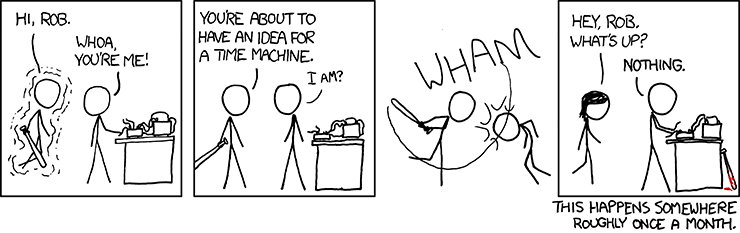
via xkcd
via xkcd
These are the CEOs and founders of the world. These are the people like Steve Jobs of Apple who say, “Phones shouldn’t be this limiting. I should be able to use my natural senses and behaviors to make the phone do what I expect it to do.” Thus, the iPhone was invented with a touch screen interface and technologies like the accelerometer that allow manipulation of the device through natural movement.
Doers, on the other hand, tend to not allow creative thinking. In fact, they tend not to be creative people. They are analytical, engineering types that look at data and extrapolate results based on that data. Doers, in the software world, are the engineers who are handed a list of specs, a timeline and budget, and are told to go and execute.
These people thrive on structure and expectations. They like to know what’s expected and, when they know, are exceptional at delivering results. Doers abhor irrational behavior and approach problems from a perspective of frameworks and architecture. They don’t venture outside their tent posts and, by doing so, are the necessary ingredient for Talkers to see their visions executed.
There really are shades in the middle, however, that are a rare breed. It’s the people in the middle, who both have the business savvy to see big pictures and allow for some degree of dreaming, yet have a firm understanding of expectations and roadmaps that make them so valuable.
See, doers rarely engage with the talkers in providing context or realistic expectation for proposals. Doers don’t really want that role. Doers get into trouble because they don’t know how to speak the language of the talkers. They don’t have the confidence, perhaps, or the desire to take a project and drive a sense of reality into a proposal. That’s above their pay grade, in their minds.
Meanwhile, talkers have an inherent nature, generally, that precludes outside input in decisions. Therefore, they don’t ask, or perhaps even think to ask, the doers for input. They create the business plans and monetization strategies, but rarely think about the implementation. By doing so, they often overlook problems that might be incurred. Talkers are usually distant from the details of the project and so, they tend to miss the detailed tactical decision making process that is employed by the doer.
Finding that personality who has the business understanding to see a 50,000 foot view, interface with management to guide a decisions in a productive manner and who also has the background and understanding to talk to the doers and collect their input is a rare, but important breed. These people should be hired immediately. Create a position if necessary but don’t let them escape.
These types of personalities tend to be excellent product managers and, in a technical environment, can really steer a product in a productive direction.
For what it’s worth, Google has instituted, for many years now, 20% time. This is the policy that states that every Google employee, regardless of role or position, is allowed 20% of their work week to work on any project that they want to. Allowing the doers, talkers and that happy middle the opportunity to be creative, to be structured and to foster ideas, has resulted in many Google Labs projects.
Notably, some of the best Google products used today, have come out of 20% time projects: Gmail, Google News and Google Reader. Additionally, many features (such as keyboard shortcuts in a variety of Google products) have also been added to existing Google products as a result of 20% time. There is even a blind engineer who created Google’s Accessible Search product.
While doers are important, and talkers are important, finding a way to foster open communication and understanding between them is essential for innovation.