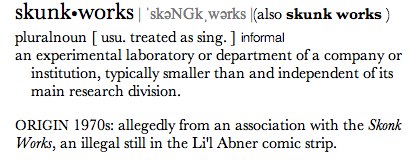
Skunkworks

Back in October, I announced my departure from WP Engine. At that time, though I didn’t talk about it on this blog, I decided to take some time off, more or less. Since 2006, I’ve been hard at work with very little time alotted to myself. I spent 2 years with b5media and jumped immediately into a failed role at Lijit (who has now been acquired by Federated Media – nice work, guys!). Upon my departure from Lijit, shortly after the market bottom in 2008, and needing money desperately, I went into full time WordPress consulting. I did that until I moved to Austin last year when I went in full time on WP Engine and stayed there for 15 months or so.

So basically, I haven’t had a lot of time to myself. So I took time. In the past few months, I’ve taken some large consulting contracts, but mostly, I’ve spent time travelling to Maryland, Seattle, Chicago – all for pleasure, nothing for work. I’ve spent time trying to weigh my priorities and wants. I’ve tossed around starting up a new company or doing something different.

At the end of the day, now that it’s 2012, I know what I want to do. It’s a bit unusual, but I think it’s important and can really revolutionize a boutique agency. I’m not comfortable doing social media work. I’m too honest and raw in my own online presence and many companies and clients may not be comfortable with my level of authenticity.

I also don’t want to do what is common among agencies – sweatshop site development. Hey, no offense. That’s what it is. Take on 30 new clients, promise them websites that are the brainchilds of the agency marketing “expertise” and ask the developers to crank them out with little to no strategic or creative input.

That might work for some developers, but I’m not a normal developer. I’m a highly established WordPress professional that has commanded 5 figure consulting deals, written a 700+ page book on the subject and have built some of the most complex WordPress solutions I’ve ever seen (Humble brag! Also proprietary, but can provide in person demos). I’m not a good fit for sweatshop site generation.

You know what agencies need that no one is doing because no one has taken the time to think outside the box? A skunkworks division. What agencies need to differentiate themselves from the thousands of other agencies they are competing with is a person or small group of people with autonomy and who are focused soley on creating disruptive technologies that no one else is doing. Try things. Fail at some, succeed at others. Test market demand. Offer exclusive access to stuff that no other agency has. Innovate, innovate, innovate.

That’s what I want to do. And someone sees the sense in that. And someone realizes that that is worth thinking outside the box for. Someone is willing to invest in that competitive advantage. Someone gets it. It’ll take money. It’ll take risk. It’ll take balls of steel. Or you can be normal. Who wants to be normal?

So as we enter 2012, I am open to conversations around this or other creative outlets you might want to explore if you want a competitive advantage. Email me at aaron@technosailor.com.

Government as a Platform?

Data, data, data. This is the answer for government in this new world of Government 2.0. Making government available to the citizens by building platforms for change. These are the ideas bandied around when the Silicon Valley Warlords came to Washington, D.C. this week to put on the invitation only Gov 2.0 Summit and teach Beltway insiders how their successes in the Valley could be instituted in the center of government.

The center of government. The center of politics. The center of policy. Of course, if the warlords have their way, the center of technology.

The concept of government as a platform is a good one on the surface. The idea that making government a series of, for lack of a better words, APIs to help the citizen understand and access their government officials and services better is a noble one. However, it is naive, and this is where the native-understanding of Washington comes into play.

The rest of the country looks at Washington as a city that is always in-fighting. That the entire ecosystem is made of bureaucratic citadels of power that never accomplishes anything. Incompetent politicians who all lie, lie, lie.

For those of us inside the beltway, we recognize that partisanship is a means to an end. That policy takes a long time to change, policy makers remain embedded as established government for years and even decades, and that politicians come and go. This is part of the expectation in our Washington. The agencies exist, made up of rank and file – the foot soldiers, if you will – and the policies in place in those agencies come from decades of precedent in some cases.

Some of it needs to be changed, and to the extent that OpenGov and Gov 2.0 can open up the doors to this change, then it will. However, some of this will never change and it’s not necessary to try to change it. Precedent generally exists for very sound reason.
lincolnmemorial

What will fail, however, is the replacement of the Washington system made up of politics, policy and also data by a fraternity-style, easy-money lifestyle of the west coast. While they talk billion dollar valuations on startups, we talk about billion dollar annual budgets for Level C agencies. Two different worlds. We have a much bigger stake, and therefore, we’re less likely to change how we do things because they suggest we should.

My suggestion is to O’Reilly and Camp: Come back to Washington, D.C. I know you’ll be back for Gov 2.0 Expo in the spring, but come back for a Summit too. Instead of dictating how the event goes, however, open it up. Make sure 50% of tickets are available for free for any verifiable government employee. (General consensus is the attendace was around 70-30, Private-public, a guess since O’Reilly Media declined to comment on attendance figures). Double the price for the private sector tickets to compensate. Here’s a hint: The federal fiscal year doesn’t begin until Oct 1. Budget money isn’t available to pay for the agency employees to attend your event. This isn’t the private sector. Money needs to be accounted for, especially during a recession. If you want this to be about government, ensure that the Feds can go free of charge and charge the Private sector double.

Secondly, allow questions from the audience. There was extremely little interaction with the audience by speakers. This needs to change if it’s going to be a learning environment.

I’d also suggest the need for a competitive event. With everyone who has dipped their feet into the Government 2.0 kool-aid, precious few have kept their noses clean from federating around this very failed event. I said in November that few of anyone has this industry figured out yet, yet the money flowing in from the Valley has caused almost everyone to sacrifice their independence and free-thinking (How many of you on that Gov 2.0 Summit Advisory Board are free to do a competitive event?)

I’d encourage some of the historically free-thinkers who have given up their independence to think about how government can really be assisted (let’s not talk about fixing government – they innovate much better than we do, actually) in different ways. I think there is room for events that will avoid the thumbprint of previous event and will federate around real ideas, not just inspiration speeches.

* Photo Credit: Big Berto

Bring Different Innovation to Washington

A few weeks ago, I received a call from my friend Robert Neelbauer at about 11 pm. He wanted to talk about innovation and technology startups in DC. For those who live around here, you know there’s not a lot of them. Mostly project-type things that entrepreneurs who work day jobs have cooking. And of course, even though DC is home to Launchbox Digital an accelerator program in the order of Techstars or Ycombinator, there remains a dearth of Silicon Valley style startups.

This call got me thinking about the landscape in DC. It is, as it always has been, a center of government. Those of us who live here joke about the difference between Washington, the center of government, and the District, a wider culture of arts, nightlife and activity outside of government. The reality is, however, that the two are inexorably fused at the hip. Spending Friday nights enjoying nightlife inevitably means spending time among people connected in Washington, on Capitol Hill or other parts of government. It is difficult to live in this city without being part of the Washington-culture somehow. More after the jump.

3531416607_3e8e066127Today, with the Obama administration and its embrace of internet culture, the advent of “Government 2.0″ has come about. Government 2.0, a term describing the second generation of government using the faux-fashionable way of versioning, describes an embrace of web technologies and culture to advance the mission of government. Without getting into my feelings on Government 2.0 as a whole (my thoughts are well-documented), it’s difficult to escape the reality of enterprise in DC.

DC is not a city lent to Silicon Valley-style innovation. We will never house the next Twitter and Google only exists here as a lobbying arm of the Mountain View, California search giant. It is a city dedicated to practical innovation. We will never have the sex appeal to attract the innovators in California here. It’s not our style.

What we do have is an opportunity for innovation as it pertains to agency mission. We do have the opportunity to develop products that meet the needs of elected government, established government and citizens in a time of economic uncertainty. We do have the ability to build products and services that meet the needs of Washington, but as long as we try to meet the needs of the country and the world, we run the risk of barking up the wrong tree.

Yahoo made a massive move last week, announcing a search deal with Microsoft. Carol Bartz, the CEO of Yahoo, suggested that Yahoo could not compete with Google anymore in search and the deal would allow Yahoo to focus and innovate in the areas they could compete. If you haven’t been paying attention to me since 2007, then you would have missed my thoughts on this. Yahoo came to grips with the realization that they couldn’t compete with Google but they could own another niche. This is the same realization that DC has to come to for itself. We can’t (nor should we) compete with Silicon Valley. Besides the fact that they are dwindling in relevancy as the spotlight shifts to other cities and reasons, we have something they can never have.

And while Silicon Valley warlords aimlessly try to find their relevancy and foothold in Washington, we have the ability to use our real connections, our real knowledge of the inside-the-beltway world, and our real grassroots abilities that we displayed in getting our President elected to bring new and relevant innovation to government.

By the way, the first person who suggests government agencies need wikis and Twitter to be relevant, is banished back to California.

It's Not Necessarily Who You Know

In the world of social media, there has been a dramatic shift in how business ideas and implementations get done. David Armano touches on it today where he suggests that knowing the influencers will get you much farther in your effort.

In that case, it’s up to all of us to find them. Perhaps take a look at something like the Power 150 and start the list backwards (or maybe get out of the marketing echo chamber all together).  If you yourself have become the new breed of “gatekeeper”"”ask yourself “is it who I know, or what they know?”. Ideally, its both””but up to us individually to strike the right balance.

Armano and I proceeded to have a lively discussion on Twitter over this idea. I agreed with his assessment  that the current landscape of the social web does cater to the idea of knowing people being more important than having a good idea. I disagreed on his conclusion that people should seek to extend their influence by knowing more of the top people on the web.

On principle, the “top people on the web” is a bit elitist and self serving. Both Armano and I enjoy being “top people on the web”, yet, I know my ability to scale is small compared to the ideas and conversations being pushed around. The web is bigger than me. It’s bigger than Armano. We both enjoy large networks of people that we know, and I don’t mean six degree of separation type stuff. We both can show you 10,000 or more collected business cards from over the years. At least I can. I presume it is the same for him.

I can brag about knowing over half of the Technorati Top 100 bloggers personally. I can point to the multitude of networking events that I attend (at least one major one every month) where I have a difficult time talking to everyone who wants to share their ideas and thoughts with me.

The problem is scale. The web is bigger than we are. You can put a gallon or five gallons or ten gallons of water in a sink, but if the drain is only an inch thick, you won’t be able to process more water out of that bin. You need a bigger drain to do that. In fact, it will take longer to drain that bin with increasingly more water. It’s physics.

Unlike Armano’s assessment that communicators, entrepreneurs, and brands should exploit the current landscape that values the personal connection over the business process (that is, good ideas can thrive on their own if they have merit), I see it as a hybrid. You must have a one-to-one network and you must have a one-to-many network, but your many-to-many network (the 2nd, 3rd, 4th, 5th and 6th degree of separation) becomes fairly useless fairly quick. Good ideas cannot thrive in a vacuum.  However, simply knowing influencers aren’t going to make it fly either.

I can’t tell you the number of people who are friends, not just business network contacts, who have talked to me with great gusto and passion about an idea and I simply look at them blankly. They know me personally, but realistically, they have a sucky idea. It’s not going to fly and no amount of knowing the right people is going to make it fly.

On the flip side, having a great idea and knowing the right people can make all the difference in the world. This is a reflection of the truth that many of the worlds greatest idea people don’t have the communication prowess to “sell” that idea and make it work. Likewise some of the greatest communicators in the world have great bullhorns, but suck at innovating themselves. So we end up in a world where we all need each other for something.

This blend of traditional (networking) and innovation is really where we need to be. We’re getting there, but we ain’t there yet. Reinforcing an unscalable paradigm of who you know as the primary enforcer of innovation is a dangerous trend that really does need to be changed. Sometime. Hopefully soon.

Update: Armano chimes in in comments and corrects the record. He is recommending a balance, as am I. Different slants on the same issue.

Changing the Currency of Influence via Search

There is no doubt that Google is the king of search but how did they become that way? In the old days (you know, before PageRank was dubbed irrelevant), the idea was that the number of links to a site, particularly by more “powerful” sites increased the relevance of an indexed page in the Google index. To this day, that philosophy holds, tho clearly the weight has shifted from “links of powerful sites” to “internal links”.

Google has not significantly adjusted how they determine the importance of an article, site or keyword in some time, tho they claim some 70+ algorithmic tweaks last year. And that’s fine. Google’s index is Google’s index. It has trained us how to search and what we expect when we search. It has taught us silently and we compare all other results to the Google results, despite the fact that Google results are in themselves arbitrary and based on their own determination via algorithm.

But I digress.

It’s interesting when new search engines or tools come out. It’s interesting to see the innovation as it takes place. One such tool that I discovered, almost by accident, does a good great job of building an index around links and pages passed around Twitter. This tool is Topsy, which combines Twitter Search with Google like results (in other words, the results are not tweets themselves).

For those of you not occupying your every waking moment on Twitter, it is by most objective measures, the new information aggregator – like RSS readers were supposed to be or portal sites try to be.

The currency of influence on Twitter can be summarized in two letters: RT (short for Retweet). Many bloggers are including the ability for stories to be “retweeted”, or redistributed on Twitter, and that is precisely what Topsy is measuring. (An example of retweeting capability on a blog can be seen on this blog – see that Retweet button at the end of the article?)

Much like Google set the currency of relevance based on links, an assumption that was valid at the time and still carries some level of validity today, Topsy has recognized that more influence is being distributed via Twitter and thus, a relevancy algorithm around this currency must be built.
Picture 5
I don’t know if Topsy is a “Google killer” or even if they strive to be one. My guess is, it will never supplant Google in our lives. However, an ambitious approach to this new distribution of influence is an important, and enjoyable, thing to watch.

Tech Community Worthless to Economic Recovery

One of the most notable things about the dot com bubble burst is that the innovations and technologies established in the late 90s and early 2000s spurned the comeback of the economy and the establishment of a new economy of business and internet value. We called it, for better or for worse, Web 2.0 and it was marked by stark innovations in human interaction driven largely by the glut of bandwidth provided by undersea cables laid in the 90s. The technology that, arguably, caused the downturn that resulted in so many dot-com bombs, became the impetus for a new generation of business and spending.

Unfortunately, this new generation of internet technology, technologists and startups is so far not demonstrating any ability to lay the groundwork for the economic recovery and innovation. Instead, we continue to focus on “teh Twitter”, and marketing gimmicks played out by celebrities like Ashtun Kutcher and Oprah. We talk about the new look and feel of Friendfeed, seen Friendfeed focusing on making what we know better, but ignoring the very impetus for economic recovery proven time again – innovation. Something new. Something radical. Something that challenges the basis of the cultural and societal problems in existence that generate the economic problems affecting everyone, not just a subset of the population existing in a subset of the worlds geography.

In the 1930s, the United States (and by proxy, the world) faced the worst economic crisis in modern history (one could make the argument that the Dark Ages were actually centuries old and worse than anything generated by modern economic recessions). It wasn’t until society was forced to innovate, via programs instituted by President Franklin Roosevelt, that the economy began to recover.

Silicon Valley, as bubble-like as it is, has been the center of innovation in the technology world, for several economic cycles now. In every case in the past 20 years, the impetus for technology growth and recovery, can be categorized by new ideas, new companies doing new things. They don’t rehash the same cycles. They haven’t focused on the same ideas. They start over building from the plateau left from the cycle before – utilizing prior technologies and developing completely new things.

This is innovation and this is not what is happening in this cycle. Instead, the technology world talks about celebrity races to 1 Million Twitter followers. They talk about the mainstream adoption of these technologies. We live in years of yore, still conversing about how Obama won the White House using social media – as if that fact will somehow change our world.

We still talk about advertising on blogs, as if advertising sales are somehow going to spur economic recovery, despite a regression in advertising spending across the board. We still build companies based on an idea that free is a valuable asset.

BREAKING NEWS: The economy spins out of control while people keep spinning stupid ideas worthy of 2001.

It’s time to get smart about business. It’s time to start applying the entrepreneurial spirit that we claim as important to our culture. It’s time for the technology community to actually be important to the economy. It’s time to stop expecting that the President will call upon us as a community of change and innovation, when all we can do is talk about publicity stunts by celebrities.

Grow up, people. Get real about making a difference. Maybe we can actually get this country and this world moving again if we stop being stupid. Maybe. We are not necessarily the chosen ones. That right must be earned.